Basmati rice holds a special place in global cuisine due to its naturally long grains, signature aroma, and elegant appearance after cooking. India leads the world in Basmati production and exports, supported by continuous varietal development over the last two decades. These newer varieties are designed to balance grain quality, cooking performance, yield, and resistance to field challenges.
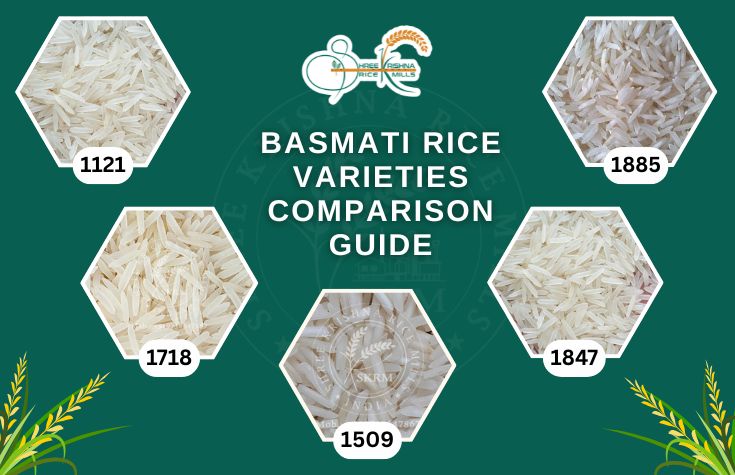
Among the most widely traded Basmati varieties today are 1121, 1885, 1718, 1847, and 1509. While all belong to the same aromatic Basmati family, each serves a different purpose depending on market preference, cooking style, and supply chain needs. This article breaks down their key differences in a practical and easy-to-understand way.
Pusa Basmati 1121 is often seen as the reference point for premium Basmati rice. Introduced in the early 2000s, it changed global expectations of grain length and elongation. Even today, it remains one of the most sought-after varieties in high-end markets.
Highest among commonly traded Basmati varieties, positioned as a premium option
Extra-long, slender raw grains
Visually appealing both before and after cooking
Strong, classic Basmati fragrance
Exceptional elongation after cooking, among the highest in the Basmati segment
Cooked grains are fluffy, well separated, and striking in appearance
Requires longer soaking and slightly careful cooking to achieve best results
Highly preferred in export markets
Considered a top-tier variety for premium buyers
Best performance when aged 12 to 18 months
Aging significantly enhances elongation, texture, and overall eating quality
Ideal for luxury biryanis, festive dishes, and premium retail or export segments where presentation and aroma are top priorities
1885 Basmati
Pusa Basmati 1885 was developed as an advanced version of 1121. It retains almost identical grain and cooking qualities while offering improved resistance to common crop diseases. This makes it more reliable at the farm level without compromising on quality.
Grain length and shape very similar to 1121
Excellent elongation with a fluffy cooked texture
Strong and pleasant Basmati aroma
Better tolerance to major plant diseases compared to 1121
Stable yields with a medium crop duration
Second highest cost among common Basmati varieties, slightly lower than 1121
Good cooking performance with grain length and elongation close to 1121, though grain strength is marginally lower
Widely accepted in export markets as a more cost-effective alternative to 1121
Aged crop is recommended, as aging improves elongation and helps reduce breakage
Best suited for premium applications similar to 1121, especially where consistent supply and lower farming risk are important
1718 Basmati
Pusa Basmati 1718 is another derivative of 1121, developed with a focus on disease resistance while maintaining core Basmati traits. It offers a balanced combination of quality and practicality.
Moderate cost, lower than 1885 but higher than 1847
Long and slender grains, slightly shorter than 1121
Good elongation after cooking, though not as dramatic as 1121
Pleasant and well-defined Basmati aroma
Cooked grains generally remain light and separate
Moderate cooking performance, with comparatively fatter grains and lower aroma than premium varieties
May show slight stickiness if not properly aged or cooked
Limited export preference, as some markets reject it due to grain length, aroma, and inconsistent cooking results
Aging is necessary for export, as it improves texture and reduces stickiness
Improved tolerance to bacterial blight, making it more reliable for cultivation
1847 Basmati
Pusa Basmati 1847 builds upon the strengths of 1509 while adding stronger genetic resistance to common rice diseases. It is designed to deliver dependable quality with improved sustainability.
Lower cost than 1121, 1885, and 1718, making it more competitively priced
Long and slender grains, comparable to 1509
Good elongation after cooking with a clean, appealing appearance
Stronger aroma compared to 1509
Good cooking performance, with grains becoming longer and thinner, non-sticky, and more consistent than 1509 as it is an improved version
Increasing export acceptance due to competitive pricing and reliable cooking quality
Well suited as an alternative for price-sensitive buyers
Aged crop is preferred for export, as aging improves elongation and firmness, though new crop can also be exported with careful handling
Early maturity with high yield potential
Improved resistance to both bacterial and fungal diseases
Ideal for high-volume domestic and export markets seeking a balance of quality, sustainability, and dependable supply
1509 Basmati
Pusa Basmati 1509 was introduced to address the need for faster crop cycles and improved water efficiency. It matures significantly earlier than traditional long-duration varieties, making it popular among farmers and bulk buyers.
Long grains with good uniformity
Moderate to good elongation after cooking
Mild to medium aroma compared to traditional Basmati varieties
Shorter soaking and cooking time
Early maturity with higher yield and lower water requirement
Lowest cost among common Basmati varieties
Moderate cooking performance, with weaker elongation and a higher tendency for breakage
Limited export preference, mostly restricted to domestic markets or budget-focused segments
Aging is recommended, as it improves elongation and helps reduce breakage
Best suited for daily meals, institutional supply, catering, and hospitality sectors where efficiency, cost control, and consistent quality are key priorities
Choosing the Right Basmati Variety
The right Basmati choice depends on how and where the rice will be used:
For maximum grain length and visual impact: 1121 and 1885
For a balance of quality and field reliability: 1718 and 1885
For early harvest, cost efficiency, and bulk use: 1509 and 1847
For sustainable sourcing with lower farming risk: 1847, 1718, and 1885
Each variety serves a distinct segment, and understanding these differences helps buyers make informed decisions. All five varieties discussed here are authentic Basmati rice, known for their aroma, slender grains, and superior cooking quality. Their differences lie in grain length, aroma intensity, elongation, cooking behavior, crop duration, and resistance to field challenges.
Whether the goal is premium presentation, everyday consumption, or long-term supply stability, selecting the right Basmati variety ensures better performance from farm to plate.