

Pusa Basmati 1 vs. Pusa Basmati 1121: A Complete Guide
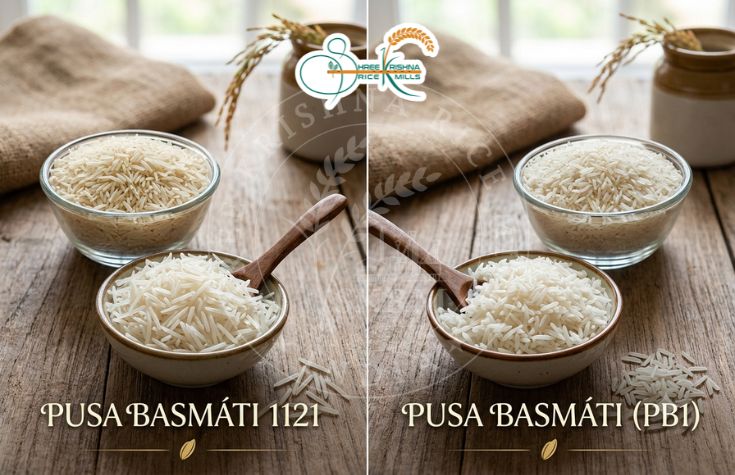
Indian Basmati rice is known worldwide for its distinctive aroma, slender grains and exceptional cooking characteristics. Among the Basmati varieties developed by ICAR-IARI, Pusa Basmati 1 (PB1) and Pusa Basmati 1121 are two important varieties with distinct grain characteristics and market applications.
Although both belong to the Pusa Basmati family, they differ mainly in grain length, cooking elongation, appearance and commercial positioning.
1. Origin and Development
Pusa Basmati 1 (PB1) was developed by ICAR-IARI as an improved Basmati variety combining the traditional characteristics of Basmati rice with improved agronomic performance. It became an important variety for commercial Basmati cultivation because of its good yield potential, slender grain and characteristic aroma.
Pusa Basmati 1121 was developed later and became particularly well known for its exceptionally long grain and outstanding cooking elongation. Its distinctive grain appearance helped establish 1121 as one of the most commercially important Basmati varieties in international markets.
2. Grain Length and Cooking Elongation
The most visible difference between PB1 and 1121 is their grain size.
Pusa Basmati 1 (PB1) generally has a raw grain length of around 7 mm, depending on crop, processing and measurement method. After cooking, the grain elongates considerably while retaining the characteristic slender Basmati appearance.
Pusa Basmati 1121 is an extra-long grain Basmati. Its raw grain commonly measures around 8 mm or more, with premium specifications often reaching approximately 8.3 to 8.5 mm. During cooking, 1121 exhibits exceptional elongation, producing very long, slender and separate grains.
This exceptional cooking elongation is one of the main reasons for the strong international demand for 1121.
3. Appearance, Texture and Aroma
PB1 produces long, slender cooked grains with a pleasant Basmati aroma and a soft, satisfying texture. It is suitable for a wide range of everyday rice dishes and traditional preparations.
1121 produces a more dramatic visual presentation. When properly cooked, the grains become exceptionally long, slender and separate, making the variety particularly popular for Biryani, Pulao and other premium rice preparations.
Both varieties have the characteristic aroma associated with Basmati rice, although the perceived aroma can vary depending on crop year, ageing, processing and cooking method.
4. Commercial Positioning
Pusa Basmati 1 (PB1) is generally positioned as a more economical Basmati option. It offers the essential characteristics expected from Basmati rice, including slender grains, aroma and good cooking quality, while providing a competitive price point.
Pusa Basmati 1121 is generally positioned in the premium and extra-long grain segment. Its exceptional raw grain length, cooking elongation and visual appeal make it highly sought after by international buyers, restaurants, caterers and consumers looking for premium Basmati rice.
The final commercial price of either variety depends on factors such as crop year, grain length, purity, processing type, ageing, quality specifications, packaging, order quantity and destination market.
5. Which Variety Is Better?
Neither variety is universally “better”. The right choice depends on the buyer’s requirements.
Choose Pusa Basmati 1121 when:
- Extra-long grain appearance is important
- Maximum cooking elongation is required
- The rice is intended for premium Biryani and Pulao
- A premium export-grade Basmati is required
- Long, slender and separate cooked grains are a priority
Choose Pusa Basmati 1 (PB1) when:
- A more economical Basmati option is required
- Good aroma and traditional Basmati characteristics are important
- Extreme grain length is not essential
- The rice is intended for regular household or food-service consumption
- A competitive price point is a priority
6. The Key Difference in One Sentence
Pusa Basmati 1 (PB1) is a long, aromatic Basmati variety, while Pusa Basmati 1121 is an extra-long grain Basmati renowned for its exceptional cooking elongation and premium visual appeal.
For international trade, buyers should always specify the exact variety, rice form, grain length, quality parameters, packaging and destination requirements rather than simply requesting “Pusa Basmati”. I would remove the claims that PB1121 was “engineered specifically” for grain length, that it has a fixed 54.5% HRR versus 48.5% for PB1, and that it accounts for “nearly 70%” of India’s Basmati exports unless you have authoritative sources for those exact figures. Those numbers can vary by study, mill, crop and reporting period, and they are unnecessary for a strong commercial comparison.