

Regular (Conventional) Rice vs. Pesticide Residue Free Rice: Understanding the Difference
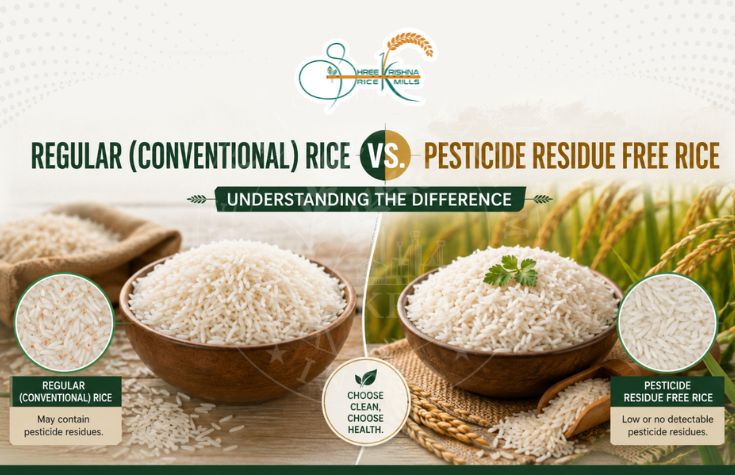
Food safety has become one of the most important considerations in the global rice industry. Importers, retailers, and consumers increasingly look beyond grain length, aroma, and cooking characteristics to understand how rice is grown and whether it meets stringent food safety standards.
One of the most common questions from international buyers is:
What is the difference between Regular (Conventional) Rice and Pesticide Residue Free Rice?
Although both types of rice can be safe for consumption and comply with government regulations, they differ significantly in cultivation practices, residue management, testing protocols, and target markets.
What is Regular (Conventional) Rice?
Regular or Conventional Rice refers to rice grown using standard agricultural practices. Farmers use approved fertilizers and crop protection products, including herbicides, fungicides, and insecticides, whenever necessary to protect crops from pests, diseases, and weeds.
These products are applied according to recommended agricultural guidelines to ensure healthy crop growth and optimum yield.
The harvested rice is processed, milled, and supplied to domestic and export markets while complying with the Maximum Residue Limits (MRLs) established by the importing country.
Features of Conventional Rice
- Produced using modern farming techniques
- Approved crop protection products are used when required
- Meets importing country’s regulatory standards
- Excellent grain quality and yield
- Cost-effective solution for bulk buyers
- Widely accepted across global markets
What is Pesticide Residue Free Rice?
Pesticide Residue Free (PRF) Rice is produced using carefully monitored farming practices aimed at minimizing pesticide residues in the harvested grain.
This involves:
- Integrated Pest Management (IPM)
- Continuous field monitoring
- Controlled pesticide application only when necessary
- Strict adherence to pre-harvest intervals
- Good Agricultural Practices (GAP)
- Laboratory residue analysis before shipment
The objective is to ensure that pesticide residues remain below the required detection or acceptance limits specified by customers or destination countries.
It is important to understand that Residue Free does not necessarily mean pesticides were never used. Instead, it indicates that the finished rice has been verified through laboratory testing to meet strict residue requirements.
Regular Rice vs. Pesticide Residue Free Rice
| Feature | Regular Rice | Pesticide Residue Free Rice |
|---|---|---|
| Farming | Conventional farming | Controlled cultivation program |
| Crop Protection | Used as required | Carefully managed and minimized |
| Residue Monitoring | Standard compliance | Intensive monitoring and testing |
| Laboratory Testing | Customer-specific | Regular residue analysis |
| Food Safety | Meets legal MRLs | Meets stricter buyer requirements |
| Price | Competitive | Premium |
| Traceability | Standard | Enhanced |
| Target Customers | General importers and wholesalers | Premium retailers and food brands |
Is Residue Free Rice the Same as Organic Rice?
No.
Many buyers mistakenly believe these products are identical.
Organic Rice
- Produced under certified organic farming systems
- Synthetic pesticides and fertilizers are generally prohibited
- Requires certification from accredited organic certification bodies
- Strict documentation and traceability
Pesticide Residue Free Rice
- Focuses on the pesticide residue present in the finished product
- May involve carefully controlled use of approved crop protection products
- Verified through laboratory residue testing
- Does not automatically qualify as Organic Rice
Why is Pesticide Residue Free Rice Becoming Popular?
Consumers around the world are becoming increasingly aware of food safety.
Large supermarket chains, premium retailers, food manufacturers, and baby food companies are demanding rice that complies with stricter internal standards than government regulations.
Demand for Residue Free Rice is growing rapidly in:
- Europe
- United Kingdom
- United States
- Canada
- Australia
- Japan
- South Korea
- Middle East premium retail sector
Benefits of Pesticide Residue Free Rice
Enhanced Food Safety
Lower pesticide residues provide additional confidence to importers and consumers.
Better Market Acceptance
Premium supermarkets and food brands increasingly prefer suppliers offering residue-tested rice.
Stronger Export Opportunities
Many international buyers specify residue limits lower than legal Maximum Residue Limits.
Brand Reputation
Supplying residue-tested rice strengthens customer trust and long-term business relationships.
Why Laboratory Testing Matters
Laboratory residue analysis plays a critical role in verifying food safety.
Modern analytical laboratories can test for hundreds of pesticide molecules using advanced techniques such as LC-MS/MS and GC-MS/MS.
Residue reports help buyers verify compliance with:
- European Union standards
- Customer-specific residue requirements
- International food safety programs
- Retail quality assurance protocols
Choosing the Right Rice for Your Business
The right choice depends on your customers and destination market.
Choose Regular Rice if you need:
- Competitive pricing
- Reliable supply
- Standard export compliance
- Bulk commercial purchases
Choose Pesticide Residue Free Rice if your customers require:
- Premium quality
- Enhanced food safety assurance
- Laboratory-tested products
- Retail or branded packaging
- Strict retailer specifications
Why Choose SKRM India?
At SKRM India, we understand that every market has unique quality and food safety requirements.
We supply both Regular (Conventional) Rice and Pesticide Residue Free Rice in a wide range of Basmati and Non-Basmati varieties.
Our strengths include:
- Advanced rice milling facility
- Strict quality control procedures
- Product traceability
- Residue testing through accredited laboratories
- Export-grade packaging
- Customized private labeling
- Global export experience
- Timely shipments
- Consistent product quality
Whether you require premium Indian Basmati Rice or Non-Basmati Rice for retail, wholesale, or food service applications, our team can deliver solutions tailored to your market requirements.
Frequently Asked Questions (FAQs)
Is Regular Rice safe to consume?
Yes. Regular Rice supplied by reputable exporters complies with applicable food safety regulations and Maximum Residue Limits of the importing country.
Does Residue Free Rice mean pesticide-free farming?
Not necessarily. It means the finished rice has been tested and verified to meet strict pesticide residue requirements.
Is Residue Free Rice Organic?
No. Organic certification and Residue Free verification are different quality standards.
Why is Residue Free Rice more expensive?
Additional field monitoring, segregation, laboratory testing, documentation, and quality assurance increase production costs.
Which countries demand Residue Free Rice?
Demand is strongest from Europe, North America, Australia, Japan, South Korea, and premium retail chains across the Middle East.
Conclusion
Both Regular (Conventional) Rice and Pesticide Residue Free Rice have an important place in the international rice market.
Regular Rice offers excellent value, reliable quality, and compliance with standard import regulations, making it suitable for mainstream commercial applications.
Pesticide Residue Free Rice provides an additional level of food safety assurance through carefully managed cultivation practices and laboratory verification. It is increasingly preferred by premium retailers, food brands, and health-conscious consumers seeking stricter quality standards.
Understanding the differences enables importers and distributors to choose the most suitable product based on their market requirements, customer expectations, and regulatory obligations.If you are looking for a trusted Indian Rice Exporter offering both Regular and Pesticide Residue Free Basmati and Non-Basmati Rice, SKRM India is ready to support your sourcing needs with quality, consistency, and global expertise.